
Charles Hoskinson says Cardano is not merely competing for crypto market share, but for a much larger role: becoming the infrastructure layer for global trust. In a June 8 livestream titled “Why Cardano is the only Ecosystem that can run the world,” the Cardano founder argued that ADA’s long-term value depends on whether the network can reduce the world’s reliance on trusted third parties and eventually surpass Bitcoin.
Hoskinson framed the current market environment as more than a downturn in sentiment. “Right now the markets are not reflecting a bear market. They’re reflecting an existential crisis,” he said, arguing that investors are asking whether cryptocurrencies “even matter” as attention shifts toward AI, synthetic biology and other high-growth technologies.
Cardano’s Endgame Is Bigger Than Token Price
His answer was that crypto’s core function has been misunderstood. In Hoskinson’s view, the industry’s purpose is not simply to create currencies or blockchains, but to reduce the cost of trust in global commerce. He estimated that the current trust apparatus in regulated financial markets, including auditing, insurance, compliance, custody, reconciliation and other intermediating functions represents hundreds of billions of dollars in annual costs.
“The solution is actually something called verifiable reflexivity,” Hoskinson said. “It’s a property. Basically, something carries its own proof of being correct.”
That concept became the central thread of the livestream. Hoskinson used voting as a simplified example: rather than relying on a trusted third party to determine whether a ballot is valid, the ballot itself would carry proof that it is legitimate. Applied more broadly, he said, the same principle could extend across finance, identity, governance, proof of reserves, solvency, settlement and social coordination.
For Hoskinson, blockchains are the storage layer for these “verifiable reflexive transactions,” while smart contracts, zero-knowledge proofs and recursion provide the machinery to make them useful. Cryptocurrencies, in this framing, are not the end product. They are the economic resource that pays for the decentralized infrastructure required to maintain the system.
Hoskinson argued that this is where Cardano separates itself from rival networks. He identified four requirements: an engine of decentralization, the right accounting model, modular expansion of major functionality, and decentralized governance capable of specialization.
On decentralization, Hoskinson pointed to Ouroboros, describing it as the protocol architecture that allows ADA to scale while becoming more decentralized rather than less. He contrasted that with systems moving toward permissioned or compliance-gated models, which he said reintroduce trusted third parties into the settlement layer.
He also highlighted Cardano’s extended UTXO model, saying it preserves local determinism while enabling programmability. That matters, in his argument, because if Alice, Bob and the network do not share the same view of a transaction, they must rely on another actor to reconcile the difference. Cardano’s design, he said, is meant to avoid that dependency.
Hoskinson then turned to Hydra and “channel isomorphism,” which he described as allowing activity to happen in specialized domains and return to Cardano “as if you did it on Cardano.” He said this gives the network a path to scale for application-specific environments, including regulated real-world assets and other specialized commercial systems.
The third piece is modularity through partner chains. Hoskinson cited Midnight as the first example, arguing that Cardano can add functionality without making the base layer excessively complex or fragile. “When you’re modular, if that module fails, it doesn’t kill Cardano, which builds trust in the underlying system,” he said.
The most unfinished part, by his own description, is governance. Hoskinson said Cardano still needs stronger “executive function” and specialization, including budget, strategy and execution functions that can identify KPIs and allocate resources. He cited possible ecosystem metrics such as user-paid fees, active developers, retained revenue, stablecoin supply, active users, stake ratio, TVL, decentralization and adjusted transfer value.
Hoskinson placed that governance challenge inside a broader argument about Cardano’s ability to self-heal. He said Cardano must survive crises, including loss of confidence in its founder, to prove that it is more than a founder-led project. “You have to lose confidence in your founder for Cardano to get to the next level because if it survives that, it means it’s a self-healing system,” he said.
The livestream also included a direct long-term market claim. If Cardano succeeds in building a system for verifiable trust, Hoskinson argued, the cryptocurrency that fuels it could become “the currency of global trust.” He added that there is “an inevitability” that Cardano can win and “surpass Bitcoin” if the ecosystem continues building toward that objective.
At press time, ADA traded at $0.16.
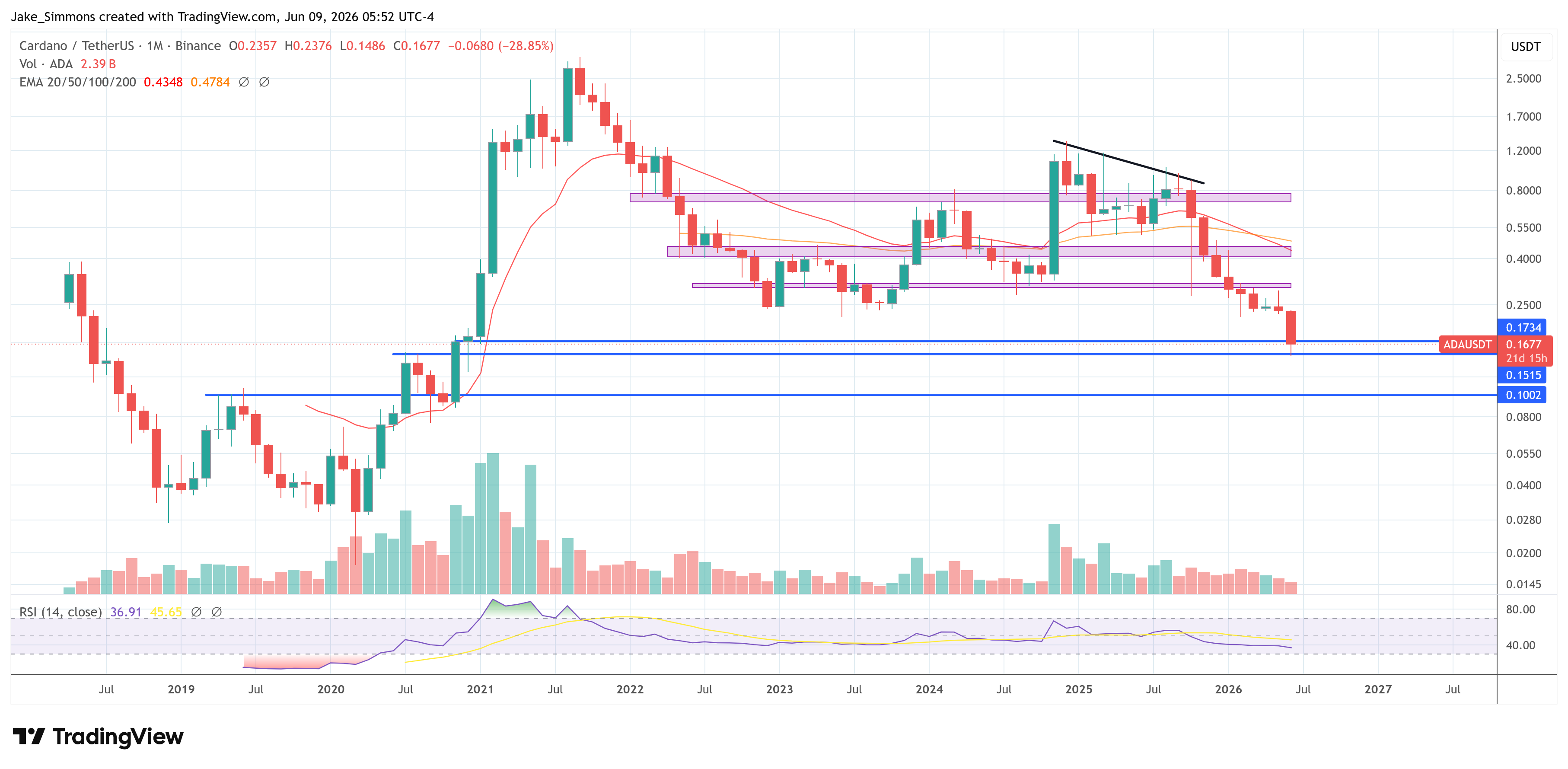
Featured image created with DALL.E, chart from TradingView.com
Editorial Process for bitcoinist is centered on delivering thoroughly researched, accurate, and unbiased content. We uphold strict sourcing standards, and each page undergoes diligent review by our team of top technology experts and seasoned editors. This process ensures the integrity, relevance, and value of our content for our readers.


